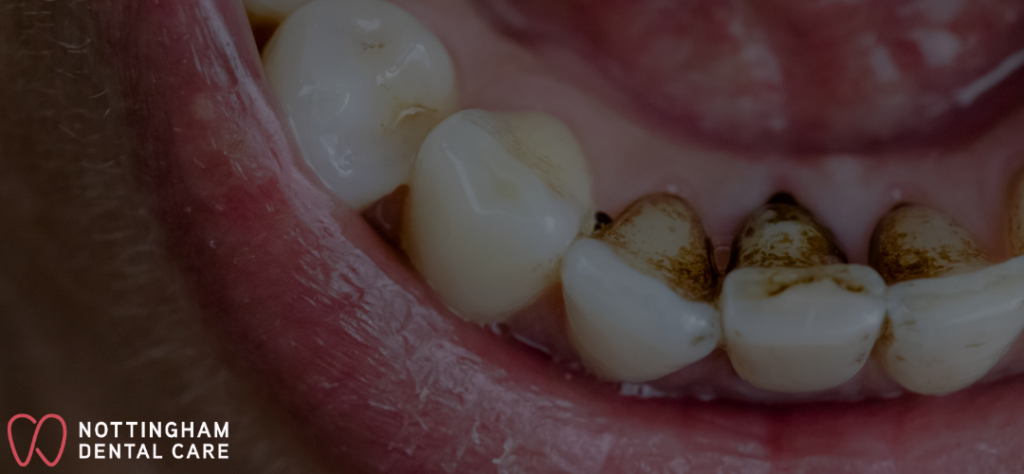
tartar off teeth - how tartar looks like

Tartar Breaking Off Teeth

Tartar breaking off teeth What it actually is, why it happens, and what you should do about it You bite into something or run your tongue along your teeth and notice a hard, rough fragment that was not there before. Or you feel a sharp edge where things were smooth. Sometimes it comes with a strange taste, sometimes it does not. The piece looks pale yellow, cream or brown, and it is hard — definitely not part of the food you were eating. What you have just experienced is tartar breaking off teeth, and it is one of those things that is alarming when it happens but is far more common than most people realise. Tartar builds up progressively, becomes brittle over time, and it does break away occasionally, sometimes in small flakes and sometimes in larger chunks. The question worth answering clearly is: does this mean something is wrong, what should you do about the piece that came off, and what does it mean for the tooth beneath? At Nottingham Dental Care on Mansfield Road in Carrington, we opened in 2026 and have already seen over 95 patients leave us five-star reviews — many of them for exactly these kinds of concerns addressed promptly and honestly. Emergency appointments are available from just £30, seven days a week. Here is the complete picture. What tartar actually is and why it forms Tartar, known clinically as calculus, is dental plaque that has mineralised. Plaque is the soft, sticky biofilm that forms on every tooth surface continuously, populated by bacteria that produce acids from the sugars in our diet. When this plaque is not adequately removed, minerals from saliva — primarily calcium and phosphate ions — deposit into the plaque matrix over days and weeks, progressively hardening it into a calcified deposit. The result is tartar: a hard, porous structure that adheres directly to the tooth surface and cannot be removed by brushing alone, regardless of technique or tool. Once tartar forms, only professional scaling can dislodge it. Tartar forms fastest in areas where saliva is most concentrated. The most consistently affected sites are: Behind the lower front teeth. The sublingual salivary glands open directly beneath the tongue in this area, bathing the lingual surfaces of the lower incisors in mineralising saliva. This is why thick tartar deposits behind the lower front teeth are almost universal in patients who do not have regular professional cleaning. On the outer surfaces of the upper back teeth. The parotid gland, the largest salivary gland, opens adjacent to the upper first molars on the cheek side. The buccal surfaces of the upper molars are correspondingly prone to rapid tartar accumulation. Tartar appears in different colours depending on its age, location and the patient’s diet and habits. Supragingival tartar (above the gum line) is typically white, cream or yellow. Older deposits or those stained by tobacco, coffee or tea take on darker brown tones. Subgingival tartar (below the gum line, inside the gum pockets) is characteristically dark brown or black from blood pigments in the sulcular environment. Why tartar breaks off Tartar does not stay permanently attached to the tooth surface indefinitely. Several factors lead to it detaching or fracturing: Age and brittleness of the deposit. As tartar matures over months and years, it becomes increasingly calcified and increasingly brittle. A long-standing deposit that has calcified thoroughly is paradoxically more prone to fracture and detachment than a softer, newer one, because the rigid structure breaks under mechanical loading rather than flexing. Mechanical forces during eating. Biting on harder foods, particularly around areas where thick deposits have formed, applies force through or against the tartar. The tartar fractures along its internal structure and a piece breaks away. Tongue or lip pressure. Patients who habitually probe at deposits with their tongue or fingernail occasionally find that a section of tartar breaks off, sometimes in a surprisingly large piece. After professional scaling. Some patients notice what feels like small pieces of tartar off teeth in the days following a hygienist appointment. This is the loosened edges of adjacent deposits that were not fully removed in one session, particularly in patients with very heavy build-up, where the initial appointment removes the bulk and subsequent appointments address what remains. What it feels and looks like when tartar comes off The experience of tartar breaking off teeth is distinctive. The piece is hard and gritty — noticeably different from food debris. It may have an irregular, rough shape. It might be small, like a grain of sand or a flake, or larger, sometimes the size of a small pebble in heavy cases. After a piece of tartar detaches, the tooth surface where it sat may feel: Rough and irregular. The fracture site often leaves an uneven edge where the remaining deposit meets the tooth, or where the tooth surface was exposed beneath the deposit. The tongue notices this immediately. Sharp. If the fracture line creates a sharp edge, this can catch on the tongue or cheek until it is smoothed. Sensitive. In some cases, the tooth surface beneath a large deposit of tartar that has been sitting against it for a long time becomes slightly sensitive when suddenly exposed. This is usually temporary and resolves within a few days. Different in taste. Dislodged tartar can have an unpleasant taste associated with the bacterial content at the deposit-tooth interface. The piece itself, if you examine it, will typically be hard and dense, off-white to yellow-brown in colour, and rough-textured. It is not soft and does not dissolve in water. Is tartar breaking off dangerous? In most cases, the answer is no. The tartar itself is not harmful when it comes off: it is a calcified mineral structure with bacteria embedded in it, and once it has left the mouth, it is no longer in contact with the gum or tooth surface. The piece can simply be discarded. The concerns that are worth paying attention to are not the piece itself, but what it