
Tartar breaking off teeth
What it actually is, why it happens, and what you should do about it
You bite into something or run your tongue along your teeth and notice a hard, rough fragment that was not there before. Or you feel a sharp edge where things were smooth. Sometimes it comes with a strange taste, sometimes it does not. The piece looks pale yellow, cream or brown, and it is hard — definitely not part of the food you were eating.
What you have just experienced is tartar breaking off teeth, and it is one of those things that is alarming when it happens but is far more common than most people realise. Tartar builds up progressively, becomes brittle over time, and it does break away occasionally, sometimes in small flakes and sometimes in larger chunks.
The question worth answering clearly is: does this mean something is wrong, what should you do about the piece that came off, and what does it mean for the tooth beneath?
At Nottingham Dental Care on Mansfield Road in Carrington, we opened in 2026 and have already seen over 95 patients leave us five-star reviews — many of them for exactly these kinds of concerns addressed promptly and honestly. Emergency appointments are available from just £30, seven days a week. Here is the complete picture.
What tartar actually is and why it forms
Tartar, known clinically as calculus, is dental plaque that has mineralised. Plaque is the soft, sticky biofilm that forms on every tooth surface continuously, populated by bacteria that produce acids from the sugars in our diet. When this plaque is not adequately removed, minerals from saliva — primarily calcium and phosphate ions — deposit into the plaque matrix over days and weeks, progressively hardening it into a calcified deposit.
The result is tartar: a hard, porous structure that adheres directly to the tooth surface and cannot be removed by brushing alone, regardless of technique or tool. Once tartar forms, only professional scaling can dislodge it.
Tartar forms fastest in areas where saliva is most concentrated. The most consistently affected sites are:
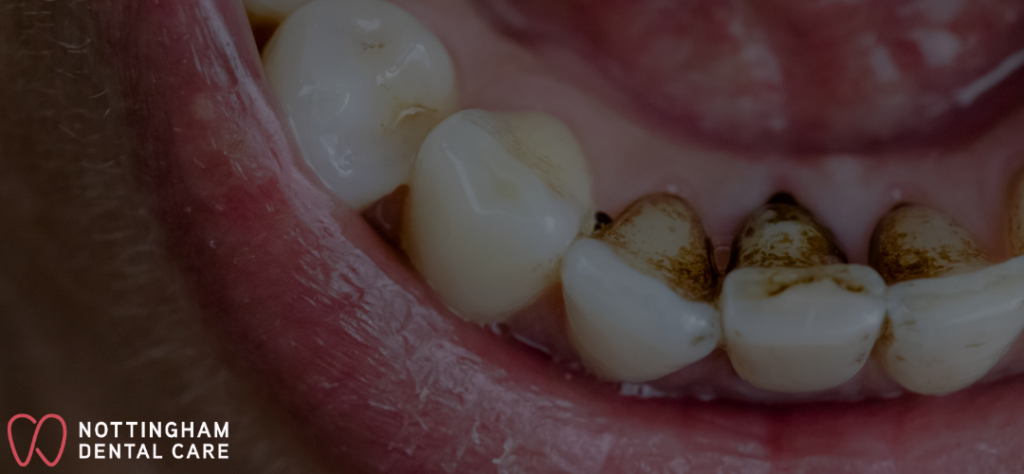
- Behind the lower front teeth. The sublingual salivary glands open directly beneath the tongue in this area, bathing the lingual surfaces of the lower incisors in mineralising saliva. This is why thick tartar deposits behind the lower front teeth are almost universal in patients who do not have regular professional cleaning.
- On the outer surfaces of the upper back teeth. The parotid gland, the largest salivary gland, opens adjacent to the upper first molars on the cheek side. The buccal surfaces of the upper molars are correspondingly prone to rapid tartar accumulation.
Tartar appears in different colours depending on its age, location and the patient’s diet and habits. Supragingival tartar (above the gum line) is typically white, cream or yellow. Older deposits or those stained by tobacco, coffee or tea take on darker brown tones. Subgingival tartar (below the gum line, inside the gum pockets) is characteristically dark brown or black from blood pigments in the sulcular environment.
Why tartar breaks off
Tartar does not stay permanently attached to the tooth surface indefinitely. Several factors lead to it detaching or fracturing:
- Age and brittleness of the deposit. As tartar matures over months and years, it becomes increasingly calcified and increasingly brittle. A long-standing deposit that has calcified thoroughly is paradoxically more prone to fracture and detachment than a softer, newer one, because the rigid structure breaks under mechanical loading rather than flexing.
- Mechanical forces during eating. Biting on harder foods, particularly around areas where thick deposits have formed, applies force through or against the tartar. The tartar fractures along its internal structure and a piece breaks away.
- Tongue or lip pressure. Patients who habitually probe at deposits with their tongue or fingernail occasionally find that a section of tartar breaks off, sometimes in a surprisingly large piece.
- After professional scaling. Some patients notice what feels like small pieces of tartar off teeth in the days following a hygienist appointment. This is the loosened edges of adjacent deposits that were not fully removed in one session, particularly in patients with very heavy build-up, where the initial appointment removes the bulk and subsequent appointments address what remains.
What it feels and looks like when tartar comes off
The experience of tartar breaking off teeth is distinctive. The piece is hard and gritty — noticeably different from food debris. It may have an irregular, rough shape. It might be small, like a grain of sand or a flake, or larger, sometimes the size of a small pebble in heavy cases.
After a piece of tartar detaches, the tooth surface where it sat may feel:
- Rough and irregular. The fracture site often leaves an uneven edge where the remaining deposit meets the tooth, or where the tooth surface was exposed beneath the deposit. The tongue notices this immediately.
- Sharp. If the fracture line creates a sharp edge, this can catch on the tongue or cheek until it is smoothed.
- Sensitive. In some cases, the tooth surface beneath a large deposit of tartar that has been sitting against it for a long time becomes slightly sensitive when suddenly exposed. This is usually temporary and resolves within a few days.
- Different in taste. Dislodged tartar can have an unpleasant taste associated with the bacterial content at the deposit-tooth interface.
The piece itself, if you examine it, will typically be hard and dense, off-white to yellow-brown in colour, and rough-textured. It is not soft and does not dissolve in water.
Is tartar breaking off dangerous?
In most cases, the answer is no. The tartar itself is not harmful when it comes off: it is a calcified mineral structure with bacteria embedded in it, and once it has left the mouth, it is no longer in contact with the gum or tooth surface. The piece can simply be discarded.
The concerns that are worth paying attention to are not the piece itself, but what it leaves behind.
- Exposed rough surfaces attract new plaque and tartar. The fractured edge of the remaining deposit, and the rough tooth surface exposed when tartar detaches, are more hospitable to new plaque adhesion than a clean, smooth enamel surface. This means the area re-accumulates tartar faster than areas that have been professionally cleaned and polished.
- The area beneath the tartar may have underlying issues. If a very large deposit of tartar off teeth breaks away and reveals a cavity beneath it, or if the tooth surface underneath is significantly eroded or damaged, this needs assessment. Decay can develop at the margins where tartar sits against the tooth surface, because the rough, porous tartar traps bacteria in direct contact with the enamel.
- If the gum was inflamed around the tartar, its sudden removal can leave gum tissue that bleeds more easily or feels sore until it recovers. This is temporary.
- Sharp edges from the fracture site can irritate the tongue and soft tissue until professionally smoothed.
When to book an appointment promptly
Some situations following tartar breaking off teeth warrant attention sooner rather than later:
- A sharp edge that is cutting the tongue or cheek. Repeated trauma from a sharp edge produces ulceration of the soft tissue that is slow to heal while the irritant is present. A dental check-up appointment to smooth the edge takes a few minutes and prevents days of soft tissue discomfort.
- Significant tooth sensitivity that is increasing rather than settling. Mild sensitivity when tartar breaks off is usually temporary. Escalating sensitivity suggests the exposure has affected the tooth beneath more significantly and needs clinical review.
- A visible cavity or dark spot revealed beneath where the tartar was. This needs assessment as soon as possible to establish whether decay has developed and, if so, to what extent.
- A bad taste or discharge from the area. This can indicate gum disease or infection in the pocket where the tartar was sitting.
- If a piece has broken off from near the gum line and the gum is now swollen or bleeding continuously. This could indicate pericoronitis in the case of wisdom teeth, or an acute gum abscess, both of which need same-day care.
For urgent presentations, you can book an emergency consultation directly online or contact Nottingham Dental Care’s emergency service for same-day assessment from just £30.
What you should never do
Never try to scrape tartar off at home with sharp instruments.
This is the most important safety point in this article. Social media has generated a wave of content showing people using dental scalers, kirby grips, pen lids and other makeshift tools to scrape deposits from their own teeth. This is genuinely risky.
The tooth surface and the gum tissue adjacent to tartar deposits are clinically sensitive. Using a sharp instrument without the clinical training to understand the tooth anatomy, the angle of approach and the force required:
- Scratches the root surface, creating grooves that harbour more plaque and bacteria than the tartar did
- Drives bacteria deeper into the gum tissue
- Causes gum recession by traumatising the gum margin
- Can push tartar further beneath the gum line rather than removing it
- Risks nicking the gum tissue and causing bleeding and infection
Professional scaling is effective precisely because it uses specifically calibrated instruments, applied with trained technique, at the correct angulation to the root surface. The result is a clean, smooth root surface that is less hospitable to bacterial adhesion. The DIY version damages the very surface it is trying to clean.
Do not ignore the rough edge or sensitivity and assume it will resolve on its own. Most cases do settle, but the ones that do not settle deserve professional attention before they progress.
What professional removal of tartar involves
At Nottingham Dental Care, the dental hygienist appointment is the appropriate mechanism for thorough, professional tartar removal.
The appointment involves:
- Supragingival scaling. Removal of calculus from the visible tooth surfaces using ultrasonic instruments, which use high-frequency vibrations to shatter and dislodge deposits, combined with a stream of water that flushes debris from the area. This removes the bulk of visible tartar efficiently and comfortably.
- Subgingival debridement. For patients with deeper gum pockets where tartar has accumulated below the gum line, hand instruments (curettes) are used to clean the root surface within the pocket. This requires more time and, for deeper pockets, may involve local anaesthetic for comfort.
- Air polishing. A jet of sodium bicarbonate powder removes surface staining and biofilm, leaving the tooth surfaces clean and smooth. A smooth surface re-accumulates plaque more slowly than a rough one.
- Assessment and monitoring. The hygienist measures gum pocket depths, assesses bleeding patterns and identifies areas of particular risk, providing personalised home care advice on which areas to focus on and what tools and techniques work best for the specific anatomy of your mouth.
The frequency of hygiene appointments is determined individually based on how quickly tartar accumulates, the health of the gums, and any risk factors. For most adults, every six months is the standard; patients with a history of gum disease or rapid tartar formation often benefit from three to four monthly appointments.
Full fees for hygienist appointments and all other treatments are available on our fees page.
Preventing tartar from forming: what genuinely makes a difference
Tartar forms from plaque that is not removed. The prevention of tartar accumulation comes down to consistent plaque removal before it mineralises, combined with professional cleaning of what home care cannot reach.
Brush twice daily with fluoride toothpaste. The mechanics of brushing disrupts the soft plaque before it can mineralise. Technique matters: reaching the gum margin and the back surfaces of the back teeth are the areas most commonly under-cleaned.
Clean between the teeth every day. Interdental brushes or floss address the contact areas between teeth where brushing does not reach. These are the areas most prone to early tartar formation and gum disease, and they need daily attention.
Use an electric toothbrush. For most patients, an electric toothbrush with a timer and pressure sensor removes more plaque than a manual brush used with variable technique and pressure.
Use a tartar-control toothpaste. Toothpastes containing pyrophosphates and zinc compounds inhibit the mineralisation process that converts plaque to tartar, slowing the rate at which new deposits form. They do not remove established tartar, but they help maintain the clean state achieved after professional cleaning.
Attend regular dental check-ups. A check-up assesses the condition of the teeth, the health of the gum tissue, and identifies any areas of developing tartar or gum disease at an early stage. Combined with hygienist appointments, this gives the most complete preventive coverage.
In conclusion
Tartar breaking off teeth is common, typically not dangerous in itself, and not a reason for alarm. The piece can be discarded. What matters is the state of the tooth surface beneath and the overall tartar load remaining.
Tartar off teeth that has broken away naturally still leaves the rest of the deposit behind. A professional hygiene appointment is the only way to remove the tartar that remains, smooth the surfaces, and reduce the rate of re-accumulation.
At Nottingham Dental Care on Mansfield Road in Carrington, we are open seven days a week. Dental check-ups and hygienist appointments are available at competitive fees listed on our fees page, and emergency appointments from £30 are available for anything that cannot wait. Call us on 0115 962 3432 or book directly online for urgent cases.
Disclaimer
The information in this article is intended for general educational guidance only and does not constitute personalised dental advice. For concerns about tartar, tooth sensitivity or gum health, please book an appointment with a qualified dental professional.
Nottingham Dental Care is a private dental practice at 473 Mansfield Rd, Carrington, Nottingham NG5 2DR, open seven days a week. We offer dental check-ups, dental hygienist appointments, emergency dental appointments from £30, Invisalign, composite bonding, porcelain veneers, teeth whitening, dental crowns and smile makeovers. Call 0115 962 3432 or book an emergency consultation directly online.
Frequently asked questions
Is it normal for tartar to break off on its own?
Yes, it is more common than most people realise. Tartar deposits become increasingly brittle as they calcify and can fracture away from the tooth surface during eating or even with tongue pressure. Noticing a hard, rough fragment that was not food is the typical experience. The piece itself is not harmful and can be discarded. The key question is what is left behind on the tooth surface, which is why a dental check-up or hygienist appointment following a significant tartar loss is a sensible step.
What should I do if a large piece of tartar breaks off?
Discard the piece and rinse your mouth gently with warm water. Assess whether a sharp edge has been left behind, whether there is tooth sensitivity, or whether there is any sign of cavity or dark spot beneath where the tartar was. A rough or sharp edge can be smoothed at a routine appointment. Significant sensitivity, a visible cavity or a bad taste from the area are reasons to book a dental check-up promptly. Severe pain, swelling or continuous bleeding warrants emergency dental assessment the same day.
Can tartar build up again quickly after it breaks off?
Yes, and often faster than on a clean, professionally polished surface. The fractured edge of remaining tartar is rough and porous, which provides a particularly hospitable surface for new plaque adhesion. The area where tartar broke off is also likely to still have a significant plaque burden at the gum margin. Without professional cleaning to smooth and clean all surfaces properly, new tartar begins forming almost immediately. This is one of the main reasons a hygienist appointment after heavy tartar loss is clinically worthwhile.
Can I remove tartar myself at home?
Home tools cannot remove tartar effectively or safely. Established calculus is bonded to the tooth surface and requires clinical instruments used with professional technique to dislodge it without damaging the root surface or gum tissue. Attempting removal with sharp objects at home risks scratching the root, pushing deposits further beneath the gum line, and causing gum trauma. Tartar-control toothpastes slow the rate of new tartar formation but have no significant effect on established deposits. Professional scaling at a dental hygienist appointment is the only safe and effective method.
How often should I have tartar professionally removed?
Most adults benefit from a professional clean every six months as a minimum. Patients who form tartar quickly (often those with naturally high calcium concentration in their saliva), who have active gum disease, or who smoke may benefit from three to four monthly appointments. The right interval is assessed at each visit based on the amount of new tartar present and the health of the gum tissue. All fees for treatment at Nottingham Dental Care, including hygienist appointments, are available on our fees page.